













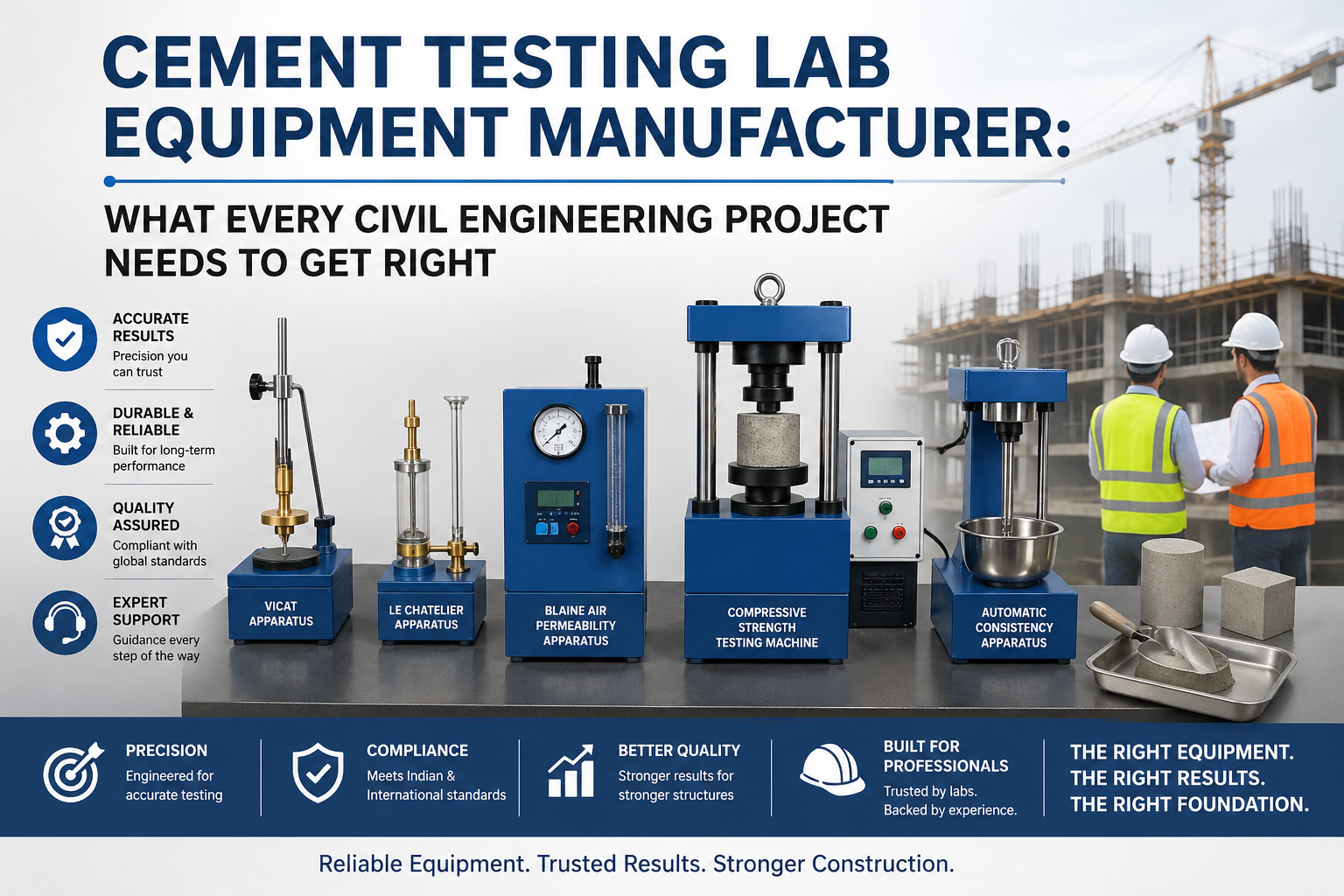
When a building collapses or a road buckles within years of construction, the failure almost never begins at the site.Nearly solid lab testing is what the failure begins with. One can say with confidence that selecting a cement testing lab equipment manufacturer is one of the most important factors for a testing facility, construction company, or engineering college. Lab testing equipment is vital for obtaining accurate results. Dangerous, costly testing equipment produces lab results that yield questionable results.
This breaks down the most important things to look for in a potential buyer of equipment, what type of equipment is needed to build the lab, and the role of the manufacturer in the level and quality of civil engineering.
Why The Manufacturer Is More Important Than The Cost.
Budget is always the starting point for most companies to some degree. This is always the case with equipment for labs. The quality of the manufacturer and the equipment for testing always determines the manufacturer’s equipment that is the most costly, and always dictates the harshest Bluetooth tests.
A civil engineering lab equipment manufacturer that is compliant with IS, BS, or ASTM standards is guaranteed to produce high quality products that stand up to audits, definitive testing, and validated results from labs of the highest quality.
Established manufacturers also give you complete quality assurance. Every piece of equipment should be accompanied by a document of compliance and seal of quality. Bu that document they offer precise results. Without it, you have produced questionable results with no substance.
Essential Cement Testing Equipment for Labs
Constructing a complete cement testing lab is more than putting together a couple machines. It is about a system that integrates machines that measure all performance aspects.
For Consistency and Setting Time
- The Vicat Apparatus for standard consistency and setting time
- Digital Automatic Vicat Apparatus for NABL-grade standardization
- For Strength Testing
- Cement Mortar Cube Molds (70.6mm x 70.6mm as described in IS 4031)
- Digital load indicator Compression Testing Machines (CTM)
- Flexure Testing Machines for tensile and bending strength
- For Soundness Testing
- Le Chatelier Apparatus
- Autoclave designed for soundness testing under steam pressure
- For Fineness Testing
- Blaine Air Permeability Apparatus
- IS Sieve Shaker with 45-micron and 90-micron sieves
- For Specific Gravity
- Le Chatelier Flask
- Pycnometer
The reliable complete cement testing lab equipment manufacturer puts this entire ecosystem into place and ensures that all available products are designed for optimal integration in your workflow.
The Interaction Between Cement Testing and Soil Testing
Cement is tested only as a part of larger processes interdisciplinary projects, e.g. highways, dams, foundations. Often labs requiring equipment for cement testing must also possess equipment for soil testing.
- Proctor Compaction Test Apparatus: tests relative cement-treated subgrade density.
- Unconfined Compression Test Equipment: tests cement-treated soil’s strength.
- CBR Test Apparatus: tests soil’s bearing capacity.
- Atterberg Limits Test Set: helps classify soil’s limit.
Having a soil testing lab equipment manufacturer that also supplies cement testing equipment makes purchasing equipment easier, provides consistency, and requires less monitoring. Companies that produce both lines of products are more inclined to have a better understanding of the equipment.
Fluid Mechanics in Civil Engineering Labs
Fluid mechanics lab equipment is essential in labs tackling hydraulics, especially to test components that deal with drainage cement products. These are often purchased alongside equipment for cement testing.
Typical Fluid Mechanics equipment consists of:
Reynolds Number Apparatus
Bernoulli’s Test Apparatus
Orifices and Mouthpiece Apparatus
Venture and Orifice Metering Sets
Pipe Friction Apparatus
Menbrane Equivalent (Hydraulic Bench Units)
A manufacturer of both fluid mechanics and civil engineering instruments is especially beneficial to universities and to those departments which are also passing the multiple laboratory departments along a single procurement process.
What Basics Should You Assess Before Engaging a Manufacturer?
Different suppliers describe themselves as civil engineering lab equipment producers, but are not necessarily of equal caliber. Below is a checklist to help guide your decision before issuing a purchase order:
Compliance to Standards — Are IS, ASTM, BS, or EN standards referenced in every product, and included in respective product spec sheets?
Calibration Certificates — Are instruments sent with traceable calibration support documents?
Material Quality — Are construction materials customizable (cast iron, stainless steel, or mild steel with a powder coating)?
After-Sales Support — Is there a warranty and is it extendable (AMC), as well as on-site service?
Installation and Training — Is there support for commissioning (study of an initiative) and training of the operators?
Lead Time Reliability — For government tenders and institutional procurement, order fulfillment cycles are enduring contracts. Can they consistently deliver on time?
NABL/ISO Credentials — Process assurance is a given with manufacturers that have NABL-accredited in-house labs or are ISO 9001 certified.
Collaborating with Engineering Colleges, Government Labs, and Private Testing Firms
The intended users of cement and civil engineering lab equipment may be categorized under three client segments that have unique needs:
- Engineering Colleges and Universities need equipment that is robust enough to endure repeated use by students, and flexible enough to comply with standards from AICTE or state technical universities.
- Government and PWD Testing Labs need equipment with full compliance documents available for BIS standards.
- Private Quality Control Labs and Contractors desire equipment that is fast, portable, and highly reliable in quasi-field conditions.
The most successful manufacturers produce a range of products that integrate institutional-grade quality, clear and comprehensive documentation, and scalable support to simultaneously satisfy all three customer segments.
10 Frequently Asked Questions
- What are the uses of cement testing lab equipment?
The apparatus are intended to ascertain the physical and mechanical characteristics of cement. This includes properties such as the consistency, the setting time and the final strength, the strength at compression, the fineness and the soundness.
- What are the regulations and standards devoted to cement testing equipment in India?
In India, cement testing is governed by IS 4031, 1st to 15th editions. All the equipment must comply with this standard.
- What is the function of Vicat Apparatus?
Vicat Apparatus determines both the standard consistency and the initial and final setting times of the cement paste. This is important in identifying if the cement can be used.
- What is the procedure to determine the compressive strength of cement?
Cement mortar cubes with a cement to sand ratio of 1:3 are prepared in standard molds and are tested at 3, 7, and 28 days after the curing, and then the load at failure is recorded, using a machine.
- What is needed to perform a soil test in the lab?
The core apparatus are Proctor Compaction Apparatus and CBR. Test Machines Direct Shear Apparatus, Triaxial Shear Test Equipment and Atterberg Limits Test Sets.
- When to use Le Chatelier Apparatus?
This device tests how cement expands. It can detect excessive free lime that can lead to the instance of long term cracking in a structure.
- Is lab equipment for fluid mechanics part of civil engineering labs?
Definitely. For civil engineering lab setups, everything from the Reynolds apparatus, Bernoulli setup, hydraulic benches, etc. is fluid mechanics lab equipment for civil engineering labs.
- Will cement testing equipment meet quality benchmarks?
You should look for IS/ASTM compliance along with legal calibration certifications, ISO 9001, past customers, and, after the sale, service availability.
- What is performed with the Blaine air permeability apparatus?
This apparatus assesses cement fineness on the basis of specific surface areas reported in cm²/g. Cement fineness has a major impact on the rate of hydration and determines the strength of the cement ingrate.
- Can a manufacturer provide both cement and soil testing apparatus?
Yes, and this is usually the recommended option. Manufacturers who provide the full suite of civil engineering lab apparatus — cement, soil, concrete, and fluid mechanics — are an excellent choice for lab procurement and help maintain a level of standard documentation for your lab.
Deciding on the manufacture for cement testing lab equipment is the start of an ongoing operational partnership that will impact your organization for the long haul. The outcomes of every test performed in your lab and the safety of every structure built using your lab outcomes will be determined by the level of precision you will be able to achieve with the provided equipment. Therefore, you must evaluate the manufacture in the field of impact insurance, quality compliance, and, impact.