













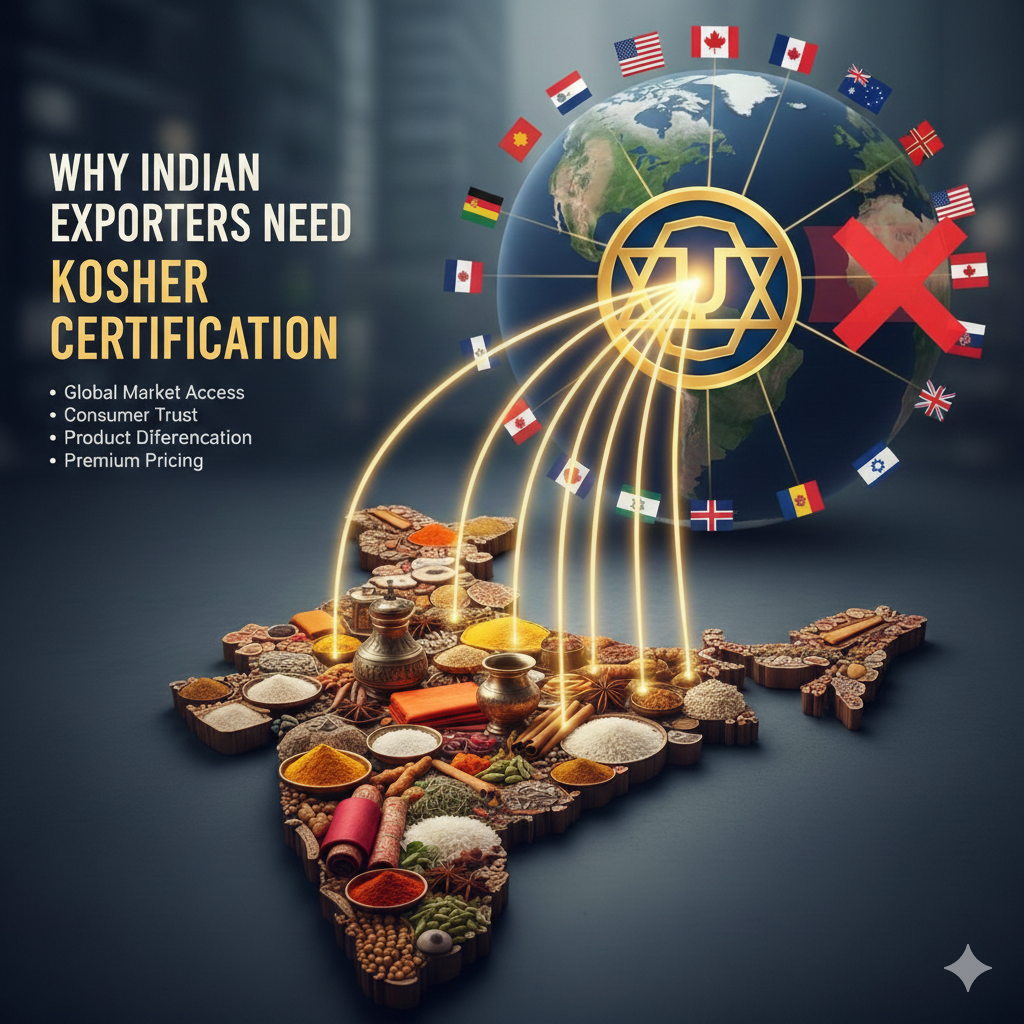
Imagine having a world-class product, competitive pricing, and strong production capacity—yet losing international buyers just because of one missing certificate. Sounds frustrating, right? That’s exactly what’s happening to many Indian exporters today when they overlook kosher certification.
In a global market where trust, compliance, and transparency matter more than ever, kosher certification has quietly become a powerful business tool. It’s no longer just a religious requirement—it’s a global quality benchmark. And for Indian exporters, it can be the difference between being shortlisted or ignored.
Let’s break it down, step by step.
What Is Kosher Certification?
Understanding Kosher Laws (Kashrut)
Kosher comes from Jewish dietary laws known as Kashrut. These laws define what foods are allowed, how they should be processed, and how equipment must be used. But don’t worry—exporters don’t need to understand religious texts. A kosher certification agency handles all of that.
Think of kosher rules as a strict quality checklist, similar to ISO or HACCP—but with added transparency.
What Makes a Product Kosher Certified
A product becomes kosher certified when:
- Ingredients meet kosher standards
- Processing equipment is approved
- Manufacturing follows strict hygiene and segregation rules
- Regular inspections are conducted by a rabbi or kosher supervisor
Once approved, the product can carry a recognized kosher symbol.
Kosher vs Vegetarian vs Halal
Here’s a common misconception. Kosher is not the same as vegetarian or halal.
- Vegetarian focuses on ingredients
- Halal focuses on Islamic law
- Kosher covers ingredients, processing, equipment, and supervision
That extra layer is what global buyers trust.
The Growing Global Demand for Kosher Products
Kosher Market Size and Global Trends
The global kosher food market is worth hundreds of billions of dollars, with the US leading consumption. And here’s the surprise—over 70% of kosher consumers are not Jewish.
Kosher has become shorthand for “clean, safe, and reliable.”
Why Non-Jewish Consumers Buy Kosher
People choose kosher products because they:
- Trust the inspection process
- Associate kosher with higher quality
- Prefer allergen transparency
- Follow vegetarian or health-conscious diets
In simple terms, kosher sells because people believe in it.
Why Kosher Certification Matters for Indian Exporters
Access to High-Value Export Markets
Without kosher certification, many US, European, and Israeli buyers won’t even consider your product. With it, doors open instantly.
Kosher certification acts like a global passport for your goods.
Competitive Advantage in International Trade
When two suppliers offer similar prices and quality, buyers choose the kosher-certified one. It’s that simple.
Kosher certification turns your product from “acceptable” into “preferred.”
Building Trust with Global Buyers
Trust is currency in international trade. Kosher certification tells buyers:
“This supplier follows strict rules, accepts audits, and values compliance.”
That’s powerful.
Top Export Destinations That Demand Kosher Certification
United States
The US is the largest kosher market in the world. Major retailers, distributors, and food brands actively seek kosher-certified suppliers.
Europe
Countries like the UK, France, Germany, and the Netherlands have strong kosher demand, especially for ingredients and processed foods.
Israel
Kosher certification is essential for exporting food and ingredients to Israel. No certificate, no entry.
Canada and Australia
Both markets have growing kosher consumer bases and strict import expectations.
Indian Products That Benefit Most from Kosher Certification
Food and Beverage Products
- Ready-to-eat meals
- Snacks and confectionery
- Beverages and juices
Spices, Herbs, and Ingredients
India dominates the spice trade. Kosher certification adds massive value to exports of:
- Spices
- Oleoresins
- Flavoring agents
Pharmaceuticals and Nutraceuticals
Kosher certification is often required for:
- Gelatin capsules
- Vitamins
- Supplements
Chemicals and Food Additives
Even non-food items like enzymes, emulsifiers, and chemicals often require kosher approval.
Kosher Certification and Indian Export Compliance
Meeting International Import Regulations
Many importers list kosher certification as a mandatory requirement. Having it upfront saves time, negotiations, and rejected shipments.
Reducing Trade Barriers
Kosher certification removes doubts, speeds up approvals, and simplifies buyer audits.
Kosher Certification vs Other Certifications
Kosher vs Halal
Some exporters think halal is enough. In reality, many buyers require both.
Kosher vs ISO and HACCP
ISO and HACCP focus on systems. Kosher focuses on systems and ingredients and supervision.
Why Kosher Complements Existing Certifications
Kosher doesn’t replace other certifications—it strengthens them.
Cost of Kosher Certification in India
Factors Affecting Certification Cost
- Type of product
- Number of ingredients
- Facility size
- Export markets
Is Kosher Certification Worth the Investment?
One new export contract can recover the entire cost. After that, it’s pure profit.
Kosher Certification Process for Indian Exporters
Step-by-Step Certification Process
Application
Submit product and facility details.
Inspection and Audit
A kosher expert reviews ingredients, equipment, and processes.
Approval and Labeling
Once approved, you can use the kosher symbol on packaging.
Common Myths About Kosher Certification
Kosher Is Only for Jewish Consumers
False. Most kosher buyers are non-Jewish.
Kosher Certification Is Too Complicated
With the right agency, the process is smooth and straightforward.
How Kosher Certification Boosts Brand Value
Premium Positioning
Kosher-certified products are perceived as premium and trustworthy.
Long-Term Buyer Relationships
Buyers stick with compliant suppliers. Kosher helps you become one.
Challenges Indian Exporters Face Without Kosher Certification
Missed Export Opportunities
Many inquiries stop the moment buyers ask, “Do you have kosher?”
Buyer Rejections and Delays
Lack of certification can delay deals or kill them entirely.
Choosing the Right Kosher Certification Agency
What to Look for in a Kosher Agency
- Global recognition
- Experience in Indian exports
- Clear communication
Importance of Globally Recognized Symbols
Buyers trust familiar kosher logos. Choose wisely.
Future of Kosher-Certified Exports from India
Emerging Markets
Asia-Pacific and Latin America are seeing rising kosher demand.
India’s Role in the Global Kosher Supply Chain
With its scale and diversity, India is perfectly positioned to lead.
Conclusion: Kosher Certification Is No Longer Optional
Kosher certification is not a luxury anymore—it’s a strategic necessity. For Indian exporters looking to grow, diversify markets, and build long-term global relationships, kosher certification is a smart, future-proof investment.
In today’s export world, compliance builds confidence—and confidence drives sales.